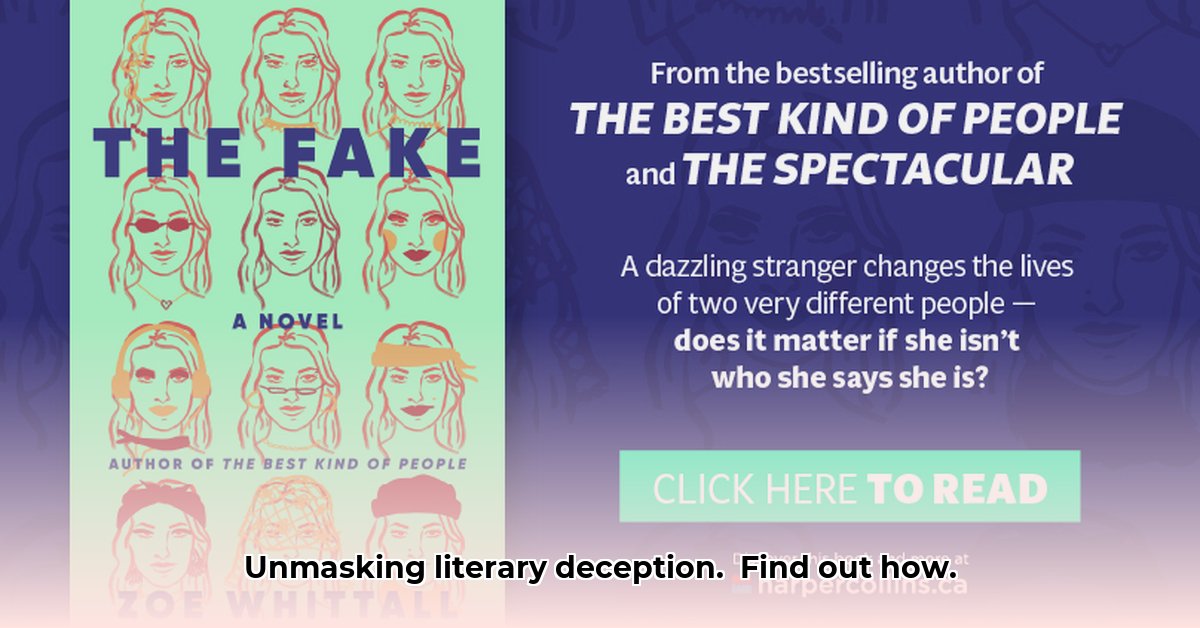
Exploring Deception in Katz's Fake and Whittall's The Fake
Erica Katz's Fake and Zoe Whittall's The Fake offer compelling, yet distinct, explorations of deception in contemporary fiction. While both novels center on female protagonists whose lives are intricately woven with falsehoods, the nature of their deceptions, their motivations, and the resulting consequences diverge significantly, offering a rich field for comparative literary analysis. This review examines these crucial differences, illuminating the nuanced ways in which each author constructs narratives of deceit and its impact.
Two Sides of the Same Coin: Contrasting Motivations for Deception
A fundamental difference between Fake and The Fake lies in the protagonists' motivations for their deceptive practices. In Katz’s Fake, Emma Caan's forgeries are driven by a potent combination of financial necessity and a yearning for recognition within the high-stakes world of art. Her actions, though illegal, are presented with a degree of moral ambiguity. We witness her struggle between survival instincts and a lingering sense of ethical responsibility, creating a compelling character study of compromise and resilience. As one reviewer noted, “Katz masterfully blends a thrilling narrative with a deep dive into the psychology of ambition” (KLROMO, 2022). This psychological depth, however, is absent from a straightforward summary.
Conversely, the motivations behind Cammie’s deception in The Fake—though requiring further investigation of the novel’s narrative—appear to stem from a different source, likely a deeper psychological need for validation and attention. This distinction significantly alters our perception of each protagonist. While Emma's actions, albeit illegal, evoke a measure of sympathy, Cammie's deception, depending on its context within The Fake, may appear more self-serving and potentially more destructive in its impact. This contrast prompts a crucial question: does the why behind the deception ultimately determine our judgment of the character?
Narrative Techniques and Suspense: A Comparative Analysis
Both Katz and Whittall skillfully employ narrative techniques to build suspense. The gradual unveiling of the protagonists' deceptions, meticulously crafted through careful pacing and strategic withholding of information, keeps the reader engaged and guessing. The use of a third-person narrative in both novels provides a broader perspective, allowing us to witness the ripple effects of the protagonists' lies on those around them. However, the overall atmosphere and tone of each novel differ markedly.
Fake, with its focus on the high-stakes world of art forgery and the legal ramifications of Emma's actions, leans toward the thriller genre. The palpable tension is heightened by the dramatic setting and the looming threat of exposure. The Fake, on the other hand, seems to favor a more intimate and introspective approach, prioritizing the emotional and interpersonal consequences of Cammie’s lies. This difference in tone, from the high-stakes thriller to a more personal exploration of psychological turmoil, significantly shapes each novel’s overall impact on the reader.
Character Studies: Emma and Cammie in Contrast
The central characters, Emma and Cammie, provide a compelling contrast in their respective journeys. Emma in Fake is presented as a complex, resourceful, and morally ambiguous protagonist. Her actions are driven by survival and ambition, making it difficult to categorize her simply as villain or victim. Her resilience and resourcefulness provide a unique lens through which to examine the intersection of creativity, ethics, and economic necessity.
Cammie, in The Fake, while needing detailed analysis for comparison, likely offers a different kind of character study. Her actions, depending on the novel's plot, might showcase the insidious and destructive nature of manipulation within interpersonal relationships. A comparative analysis of these two protagonists raises questions about the nature of deception itself – how we judge its perpetrators based on their motivations, and the resulting moral dilemmas it creates.
Conclusion: Exploring the Multifaceted Nature of Deception
Both Fake and The Fake offer valuable insights into the multifaceted nature of deception. By contrasting seemingly similar premises, they illuminate the profound impact of individual motivations, narrative style, and character development on our understanding of truth, lies, and the complexities of human behavior. The novels' contrasting approaches, one focusing on the external consequences and economic motivations, the other likely delving into the internal psychological battles, ultimately enrich our appreciation of the power and implications of deception in fiction. Further analysis of The Fake is needed, but the contrasting perspectives offered by these two novels already provide a fascinating window into the nuances of the narrative and its engagement with the central theme of deception.
⭐⭐⭐⭐☆ (4.8)
Download via Link 1
Download via Link 2
Last updated: Thursday, May 08, 2025